Why SEO is easy to measure and steer
SEO has become a predictable field. You can track performance accurately and make targeted optimizations whose effect often becomes visible within a reasonable time.
Measurable: performance can be tied directly to metrics such as rankings, clicks, impressions and conversions.
Steerable: SEO has concrete things to implement, such as metadata, structured data and canonical URLs, and their effect is often measurable.
Why GEO is still a black box
With GEO, that predictability is still missing. AI models work differently from search engines and offer far less insight into why a brand is or isn't mentioned.
Hard to measure: AI visibility has no fixed position and varies per prompt. That makes its effect difficult to track in analytics.
Technically still evolving: more and more optimizations are emerging, but there is no mature equivalent of SEO yet. Important developments are:
llms.txt: a proposed text index for your most important content. This is not yet a widely adopted standard.
Entity and schema markup: this lets a model recognize your brand as one clear thing, instead of as loose pieces of text.
Answer-oriented content structure: direct, quotable sentences instead of long, build-up paragraphs.
Off-site presence in places that models use as sources, such as Wikipedia and Reddit.
What the research shows
The 4 technical points above are worth implementing either way. Still, it's hard to keep up in a market that changes extremely fast, with big differences between the platforms on top of that.
Market share is shifting fast
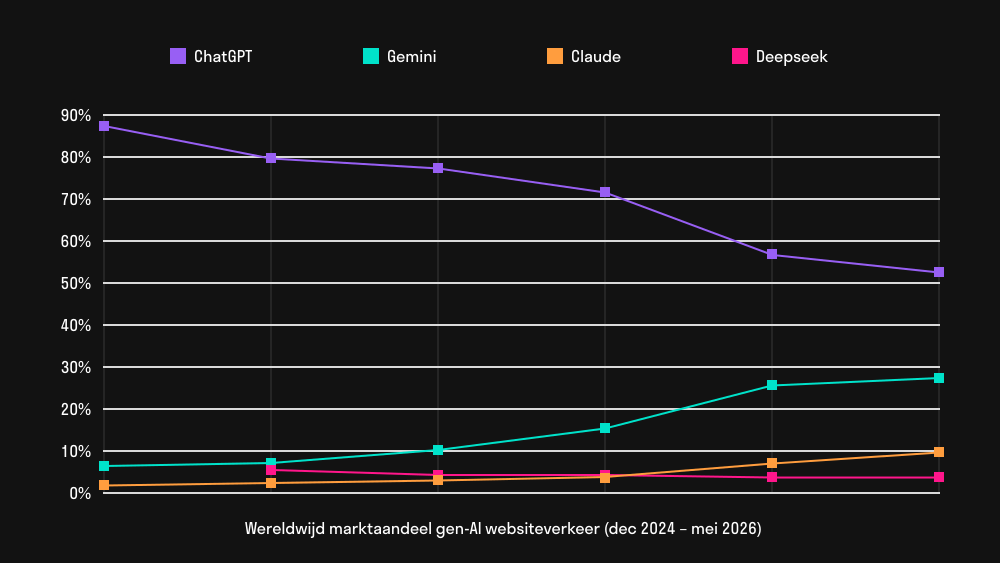
The Similarweb research shows how quickly the market shifted between September 2024 and March 2026:
ChatGPT grew by 84%
Gemini grew by roughly 800%
Claude grew by roughly 770%
What that growth has led to is shown by more recent figures from Momentic, based on Similarweb data from May 2026: ChatGPT still holds the largest position with a 53.9% global market share, followed by Gemini at 27.9% and Claude at 9.2%. So ChatGPT remains the biggest player, but in a short time the market has changed from a one-sided market into a competitive one.
Each model has its own preferences
There is another complication that SEO doesn't have: the major language models cite completely different sources. Profound analyzed 680 million citations across ChatGPT, Google AI Overviews and Perplexity, and found big differences in which sources each platform cites most often in its top 10. ChatGPT leans heavily on Wikipedia, which accounts for 47.9% of its top-10 sources. Perplexity is a completely different story: there Reddit accounts for 6.6%, and in Google AI Overviews for only 2.2%.
The Otterly.ai research also looked at Claude: 379,321 citations across 16,406 domains. Claude mainly cites brand sites, which account for 64% of all citations, versus 14.9% for news and media. Reddit is missing entirely, not cited a single time, while it is one of the most important sources for ChatGPT and Perplexity. Compare Claude with ChatGPT and only 13% of the cited domains overlap, and at URL level just 4.2%.
How do you make the black box more transparent?
Without tooling you'll have to check this manually, prompt by prompt, but that obviously doesn't scale. Otterly.ai is a dedicated GEO tool, built to track which sources AI engines cite and how often your brand is mentioned. You put together a set of prompts your target audience would ask, and the platform sends them daily to different models, such as ChatGPT, Perplexity or Google AI Overviews. Per prompt you see whether your brand is mentioned, which competitors are mentioned alongside it, how positively or negatively your brand is described, and which pages are cited as sources. A GEO Audit feature assesses individual pages on how well AI engines can pick them up, before you even publish.
Integration with Storyblok
If you work with Storyblok, there is an extra reason to keep an eye on Otterly.ai: it is available as an official "Content Observability" add-on on Storyblok's Premium and Elite plans. That brings creating content, publishing it and monitoring it in AI search engines together in one subscription.
Getting started
Start small. Put together a fixed set of prompts based on the questions your target audience actually asks, rather than on keywords. Periodically monitor whether AI models cite your brand, and whether your competitors are among them. Use those insights to adjust your own content in a targeted way, and measure whether your AI visibility improves as a result.
Want to connect GEO insights to your existing content workflow in Storyblok? We'd be happy to help you set up a measurable approach with Otterly.ai.